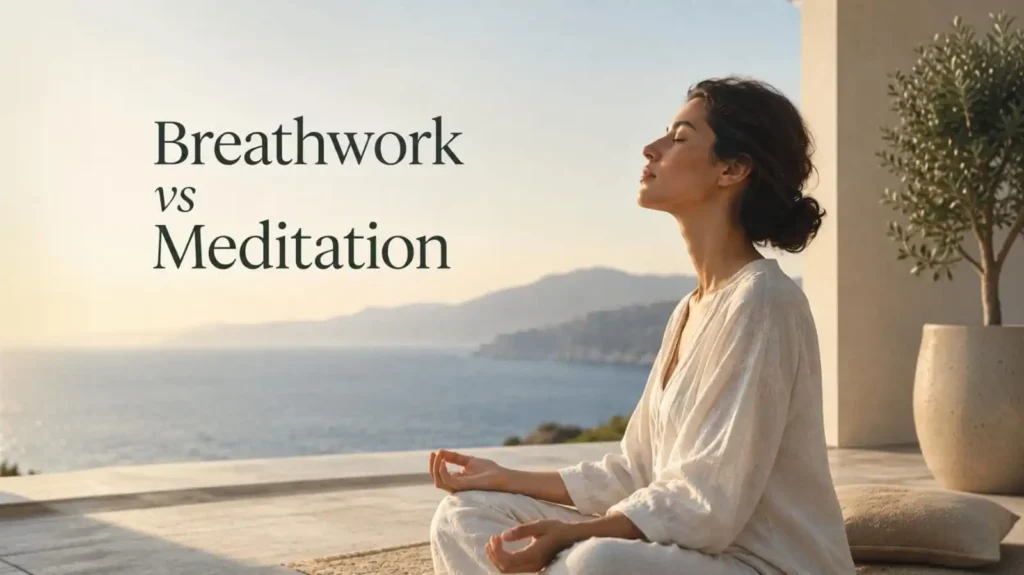
Breathwork vs Meditation: What’s the Difference?
Breathwork and meditation are often mentioned in the same breath — sometimes literally — and it is easy to assume they are interchangeable. Both are practices that support calm, focus, and self-awareness, and both have a long history of use around the world. But they work in fundamentally different ways, and understanding that difference can help you choose where to start, or how to use both together.
How Meditation Works
Meditation is largely a practice of stillness and observation. You sit, focus your attention — often on the breath itself, a mantra, or simply the present moment — and train yourself to notice thoughts without being pulled into them. It asks very little of you physically, which is part of its appeal, but it also means the mind is doing most of the work from the very first sit. It is quiet, often solitary, and its benefits tend to build gradually, strengthening with consistent daily practice rather than delivering a dramatic shift in a single session.
How Breathwork Works
Breathwork takes a more active approach. Instead of observing the breath as it naturally happens, you are guided through a specific, deep, rhythmic breathing pattern designed to shift your physical and emotional state directly. Because it works through the body rather than through stillness of mind, many people notice something happening in their very first session — a release of tension, a wave of emotion, or a sense of calm that can feel more immediate than what meditation offers early on. The structure of the practice gives your attention somewhere to go, which many beginners find easier to stay with.
What About Yoga?
Yoga is often grouped alongside breathwork and meditation, and it shares elements of both — movement paired with breath, and a meditative quality once you settle into a pose. Where breathwork and meditation are almost entirely internal practices, yoga adds a physical, external layer that some people find easier to engage with, and others find distracting from the internal work. None of the three is “better” than the others; they simply meet different needs, and many people who explore
breathwork in Dubai eventually build a practice that draws from
more than one.
The Core Differences
A few distinctions tend to matter most when people are deciding where to begin:
•Primary tool: meditation uses stillness and observation; breathwork uses active, guided breathing patterns.
•Pace of results: breathwork often produces a noticeable shift in a single session; meditation typically builds gradually over weeks of consistent practice.
•Guidance: breathwork is usually led live by a facilitator, at least at first; meditation is commonly practised alone, with an app or teacher as an optional guide.
•Best entry point: breathwork tends to suit people whose minds are too busy to sit still; meditation suits people who want to build a quiet daily habit.
Common Myths Worth Clearing Up
A few misconceptions come up often. The first is that breathwork requires some kind of spiritual belief system — it does not; the practice is physiological, not religious. The second is that meditation is “easier” because you are just sitting still — in practice, many beginners find stillness harder than an active breathing pattern, not easier. The third is that you have to choose one permanently. Most long-term practitioners move between the two depending on what a particular day calls for, using breathwork when they need a faster reset and meditation when they want to build a quieter daily habit.
Choosing Based on What You’re Working Through
For everyday stress or a racing mind before bed, meditation’s slow, steady approach often works well because it trains the mind to settle over time. For acute stress, a difficult day, or the sense of being “stuck” in your body, breathwork tends to offer more immediate relief because it works through the body’s physiology rather than asking the mind to calm itself first. For sleep specifically, many people find a short breathing pattern in bed more effective than trying to meditate while already lying down, simply because meditation can be hard to distinguish from drifting off. And for processing something emotional — grief, a big decision, a transition — breathwork’s guided, held format often creates more space to actually feel what needs to be felt, with a facilitator present rather than working through it entirely alone.
Which Should You Start With
If sitting in silence makes you more restless, not less, breathwork is often the more accessible starting point — you are given something active to do with your attention, which can make the practice easier to stay with from the first try. If you are looking for a daily habit you can do anywhere, anytime, without guidance, meditation may be the better long-term foundation. There is no wrong choice here, only the one that matches how your mind tends to work.
Can You Do Both
Yes — in fact, many people find the two practices complement each other well. A breathwork session can create the physical calm that makes it easier to sit in meditation afterward, while a regular meditation practice can deepen the awareness you bring into a breathwork session. Some clients also pair breathwork with
coaching sessions, using the clarity a session brings to
work through a decision or a pattern they want to change.
Building a Simple Weekly Practice
You do not need to overhaul your routine to benefit from either practice. A realistic starting point is one guided breathwork session every few weeks, paired with five to ten minutes of quiet sitting on the days in between. Over time, many people find their own rhythm — leaning more on breathwork during especially demanding weeks, and more on meditation when things are steadier. What matters most is consistency over intensity; a short daily habit will generally outperform an occasional long one.
It is also worth remembering that neither practice needs to be perfect to work. A breathwork session where your mind wanders, or a meditation sit that never quite settles, still moves your nervous system in the right direction. Progress with both tends to be cumulative rather than immediate — the value shows up less in any single session and more in how your baseline shifts over weeks and months of showing up.
Final Thoughts
There is no wrong door into a calmer nervous system. If you are curious to try the more active route first,
S Motion offers guided Transformational Breath® sessions in Dubai, in person or
online, with certified facilitator
Fatemah AlMarzook. Message on WhatsApp to book a session
and feel the difference for yourself, or explore the full range of
coaching and wellness services
available